Vincent Indelicato's murder and cover-up
Inherent ViceVincent Indelicato's murder and its cover-up expose how Adrian Prussia can kill a Los Angeles police detective and still remain protected by the department. When Doc reads the record identifying Indelicato as the victim, he recognizes him as Bigfoot's longtime partner and understands the melancholy Bigfoot has kept unspoken. The case turns a concealed death into evidence of a wider arrangement: Prussia's repeated escapes from prosecution, the LAPD's suppression of the truth, and the use of Doc as an outsider willing to keep asking questions.
Background and the Suspected Killing
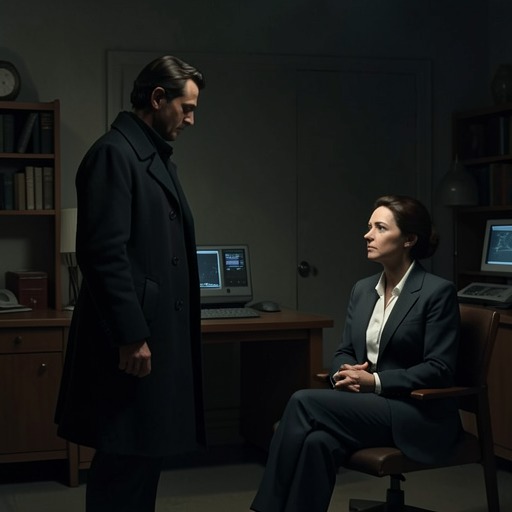
The killing enters Doc's investigation through a theory about the arrest of Puck Beaverton. Doc reasons that a detective—whom he initially calls Officer X—may have arrested Puck on a minor drug-seed charge in the hope that Puck's record would send him back to Folsom. If Puck did not retaliate against the detective, Doc suggests, Adrian Prussia had a reason to do so: the arrest could make Prussia look weak if one of his former associates faced imprisonment. In this account, the detective's death may have been a strike not only against Puck but against Prussia's standing and control.
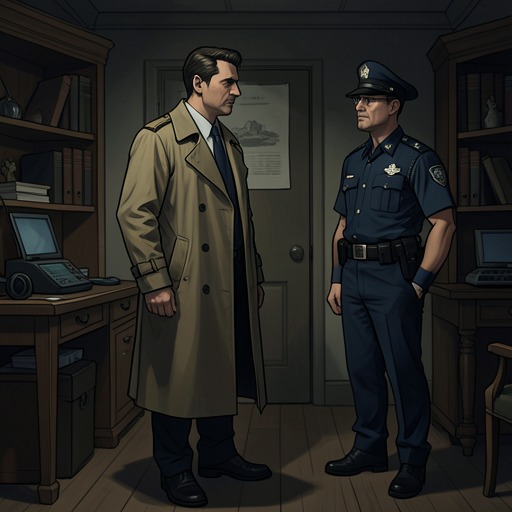
Bigfoot confirms the scale of the danger without presenting the killing as an isolated act. He tells Doc that Prussia has been a prime suspect in a number of homicides and has walked each time after intervention from the highest levels. The murder of Indelicato thus belongs to a pattern in which suspicion repeatedly fails to produce a trial or lasting accountability. Bigfoot also insists that the LAPD is not a single-minded institution with one purpose: he compares its internal world to a prison yard of rival groups, addicts, informers, and armed people. His account makes the killing legible as a crime within a fractured institution, not simply as a contest between police and their outside adversaries.
The Official Account and the Record
Doc finds the account in a file Penny has unsealed in her cubicle. On a beat-up wooden table, beneath top-secret stickers, sits the record of Prussia's history with the California Public Code, including numerous escapes from punishment for murder. The file's bureaucratic form matters: a death that Bigfoot has kept out of ordinary conversation is preserved as a sequence of legal arguments, arrests, and dispositions. Reading it, Doc immediately sees why the department would not want the material known and worries that Penny may have put herself in danger by making it accessible.
The file identifies Detective X as Vincent Indelicato. Prussia's lawyers argued that the shooting was justifiable: Prussia, described as a widely respected businessman, claimed he believed someone was entering his beach apartment on Gummo Marx Way, mistook the person for the angry husband of a female acquaintance, and thought he had seen a gun. The account further represented Prussia as distressed to learn that the person he had shot was an LAPD detective he had met through his ordinary business dealings. These claims form the defense recorded in the file; the surrounding pattern of repeated cases and failed prosecutions makes the official explanation part of the larger uncertainty rather than a resolution of it.
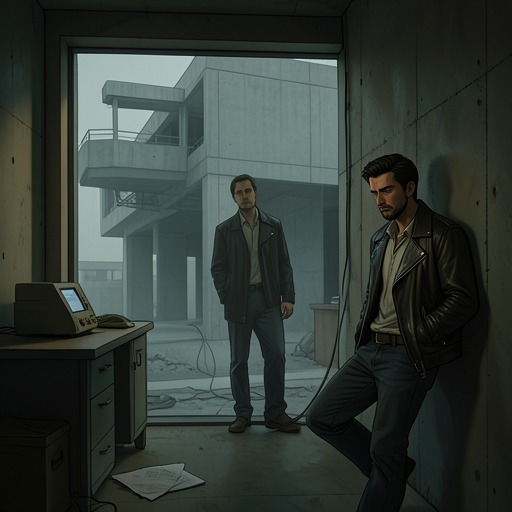
The person who identified Indelicato's body was his partner of many years, Lieutenant Christian F. Bjornsen. Doc recognizes that this is Bigfoot, whose present-day distance from his former partner—he no longer rides with him, talks about him, or even names him—had seemed inexplicable. The record therefore supplies a crucial personal fact as well as a case detail: Bigfoot's silence is bound to grief. Doc's brief spoken reaction gives way to a recognition that the detective's death and Bigfoot's grief are inseparable from the institutional story he is uncovering.
The Cover-Up and Its Machinery
Bigfoot imagines the possible responses to the killing and rejects them one by one: he does not pursue Prussia with a weapon or attack him through some private act of revenge. Instead, Bigfoot finds a civilian private investigator who will continue probing the case, even clumsily enough to attract attention. Doc understands this as a dangerous form of delegation. If someone comes after the investigator, the partner whose death provoked the inquiry will not be there to protect him; Bigfoot's use of Doc as an investigator does not amount to a promise that he can keep Doc safe.
The cover-up reaches beyond one favorable legal argument. Bigfoot says that Internal Affairs can lock the case away for decades while the department presents the death as another officer killed in the line of duty. That concealment erases the distinction between Indelicato's murder and the genuine deaths of police heroes, and it denies colleagues the chance to respond openly to what they may know. Bigfoot's anger is directed not only at the suspected killer but at a professional culture that can know or suspect the truth and still refuse public accountability.
The earlier cases in Prussia's file show how the protection operates without requiring every accusation to be formally disproved. He has been arrested, questioned, arraigned, and indicted; cases nevertheless fail to reach trial or are bargained down. The stated reasons vary: evidence may be insufficient, inadmissible, or circumstantial, the body may be missing, or another person may come forward and accept responsibility. Doc concludes that, whatever the exact connection between Prussia and the department, Prussia might as well be working as its contract killer. The record does not establish a single explicit order from the LAPD for each crime; it does show the recurrent result, in which prosecutions dissolve and Prussia walks.
Debts, Influence, and the Wider Network
The investigation connects Prussia's safety to a portfolio of IOUs. The amounts are not necessarily large, but each debt is sufficient to guarantee obedience from the person who owes it. Prussia receives the money and interest; the people with power over the debts receive the actions they want carried out. The account frames debt as more than a private financial arrangement: it is a means of command, linking Prussia to people able to direct behavior while remaining less visible than the person doing the work.
The same network crosses the boundaries between local policing and federal interests. Agent Borderline tells Doc that federal agents have their own information and asks about Motella Haywood and Lourdes Rodriguez, employees of Kahuna Airlines, while noting that Bigfoot's cooperation with federal investigators is likely to be limited. Later, Bigfoot explains that federal agents learned that Mickey Wolfmann, an acidhead billionaire, intended to give away his money. Their association with the Golden Fang through heroin-related activity in the Far East gave them another means to intervene: they had Mickey taken to Ojai for brain work and, in Bigfoot's account, programmed. This account does not make the federal operation identical to the Indelicato cover-up, but it places both within a story where institutional actors pursue their own ends through concealed relationships, selective cooperation, and control over individuals.
Significance in the Investigation
The murder's importance lies in the way it changes the meaning of Bigfoot's behavior. His silence about Indelicato first appears as an absence in the investigation; the file makes it readable as mourning, while Bigfoot's enlistment of Doc shows how grief is redirected into an inquiry he cannot safely conduct himself. Doc, in turn, is not merely handed a name or a suspect. He is drawn into the space between public procedure and private knowledge, where the official record can describe a defense, the department can close ranks, and repeated suspicions can leave a powerful suspect untouched.
Indelicato's case also supplies a concrete instance of the novel's wider pattern of connected but partially concealed systems. Prison affiliations explain why an arrest might matter to Prussia; debts help explain how commands travel; departmental secrecy shields the outcome; and Bigfoot's personal loss gives that structure a human cost. The cover-up is therefore not only the withholding of a fact. It is the process by which the fact is converted into an acceptable official story, while the people who know more are divided by fear, institutional loyalties, or grief.